When Zalando set out to explore AI for Procurement, the motivation was clear: the tools were there, the interest was high — but impact was limited.
Procurement teams were already experimenting with Google Gemini and other AI tools, and as usual, the team is always aiming at becoming a world class organisation, which includes state of the art technology, pushing the envelope and testing new solutions. In order to achieve this, the Procurement at Zalando recognised an important truth early on: AI adoption would not succeed through tools alone. What was missing was enablement — a structured way to turn experimentation into real capability.
The Turning Point
Zalando Procurement accelerated AI adoption by transitioning from fragmented tool experimentation to a structured PMA Academy Enablement journey. By combining theory with a hands-on Promptathon, the organization shifted AI from a novelty to a core procurement capability, resulting in faster supplier analysis, data-driven negotiations, and reduced manual preparation times across the function.
The programme combined two online learning waves with a hands-on onsite Promptathon, deliberately moving away from passive learning and towards applied practice. From the beginning, the focus was not on creating “prompt experts”, but on helping procurement professionals think better, faster, and more strategically with AI.
As one core principle guided the programme: AI needs a playground — not just policies.
From AI Experimentation to Application with PMA Academy Promptathon
During the online sessions, participants built a shared understanding of how large language models work and where their limits are — always anchored in real procurement tasks. Instead of abstract examples, teams worked on sourcing scenarios, supplier strategies, offer comparisons, RfP creation, and negotiation preparation.
The onsite Promptathon became the decisive moment. Working on Zalando’s own procurement use cases, participants tested, refined, and challenged AI outputs together. They learned not only how to get better results — but also how to validate them, question them, and integrate them responsibly into existing workflows.
What changed was not just skill level, but mindset. AI stopped being something “experimental” and became a practical support tool embedded in daily work.
What It Delivered
By the end of the programme, the difference was tangible.
Procurement professionals were actively using AI across multiple use cases — from faster offer comparisons to more structured supplier analyses and clearer negotiation preparation. Manual effort was reduced, preparation times shortened, and discussions became more data-driven and consistent.
Just as importantly, confidence increased significantly. Teams shared a common AI language, understood what was allowed, and knew when AI added value — and when it didn’t. Leadership could see concrete results instead of vague potential.
As one key stakeholder put it during the programme: “We don’t want to create prompt engineers. We want people who can think better with AI — and that’s exactly what happened.”
The Real Success
The real success of the Zalando programme was not a single output or tool. It was the shift from AI as a novelty to AI as a capability.
AI became a normal part of professional procurement conversations. Teams stopped asking “Should we use AI?” and started asking “How do we use it best for this task?”
What began as curiosity turned into confidence — and from there into measurable value.
Why It Worked
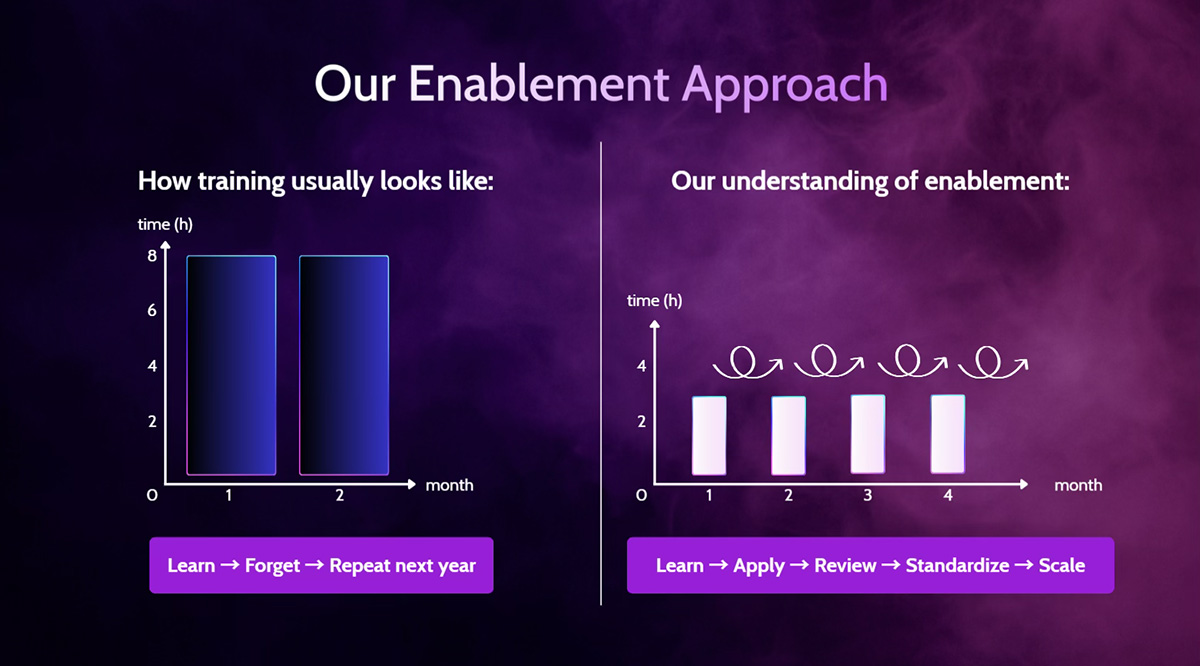
Because the PMA Academy course did not teach AI. It enabled people.
By combining real use cases, leadership involvement, safe experimentation, and structured reflection, Zalando’s Procurement teams moved beyond hype and into performance. And that is what sustainable AI Enablement looks like.
Check out our AI Enablement for Corporations courses.
Authors:

Daniel Zinner is an international HR expert, entrepreneur, and communications consultant. His expertise lies in HR, strategy, digitalisation, and transformation strategy.

Alexia Schmolling is the Head of Operations and Academy Lead at PMA. Her focus lies on Expat Management, Employee Health and international HRM. She brings valuable insights from her international experiences.