How to Turn AI Curiosity into Organisational Capability
Challenge
Artificial Intelligence has entered corporate reality fast. Across corporate functions — HR, Global Mobility, Procurement, Finance, Legal, Operations and beyond — organisations face similar situations:
Licences were purchased. Tools were introduced. Webinars were attended. Employees experimented with ChatGPT and prompts were even shared internally. And yet, months later, many leadership teams were asking the same question: Why hasn’t anything really changed?
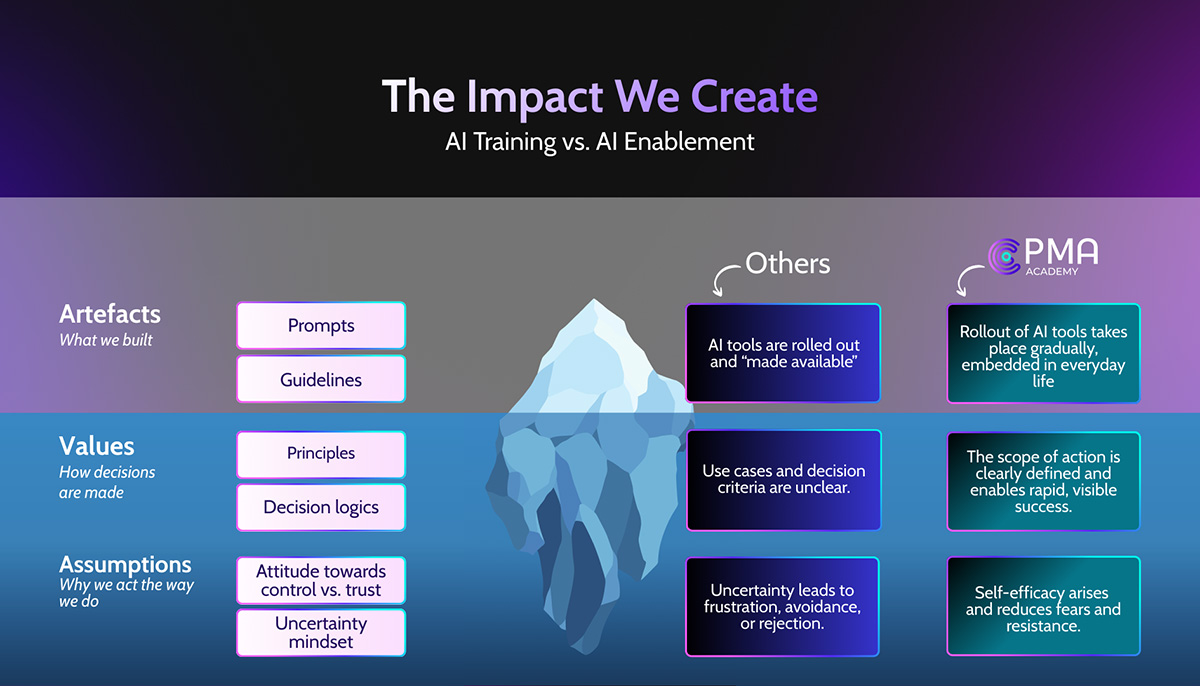
In most organisations, daily work remains unchanged. Why? Watching tutorials does not change how people work. Knowing prompts does not mean knowing how to apply AI to real business tasks. Tool access does not equal capability.
AI potential remains disconnected from operational reality. However, the issue was not technology. It was enablement.
The Underlying Problem
In nearly every organisation we worked with, employees had already started exploring AI tools on their own. They watched tutorials, tested prompts, read LinkedIn posts and exchanged tips. But experimentation alone does not transform workflows.
Most professionals struggled with three core questions:
- What exactly should I use AI for in my role?
- How do I integrate it into real tasks instead of testing random prompts?
- When can I trust the output, and when should I not?
Without clear answers, AI remained something “interesting” rather than something “useful.” After one or two unsatisfying attempts, many employees simply returned to their old ways of working. This is where most AI initiatives stall.
Without structure, AI remains a toy — not a tool. That is why AI Enablement is required.
The System: From Tool Introduction to Capability Architecture
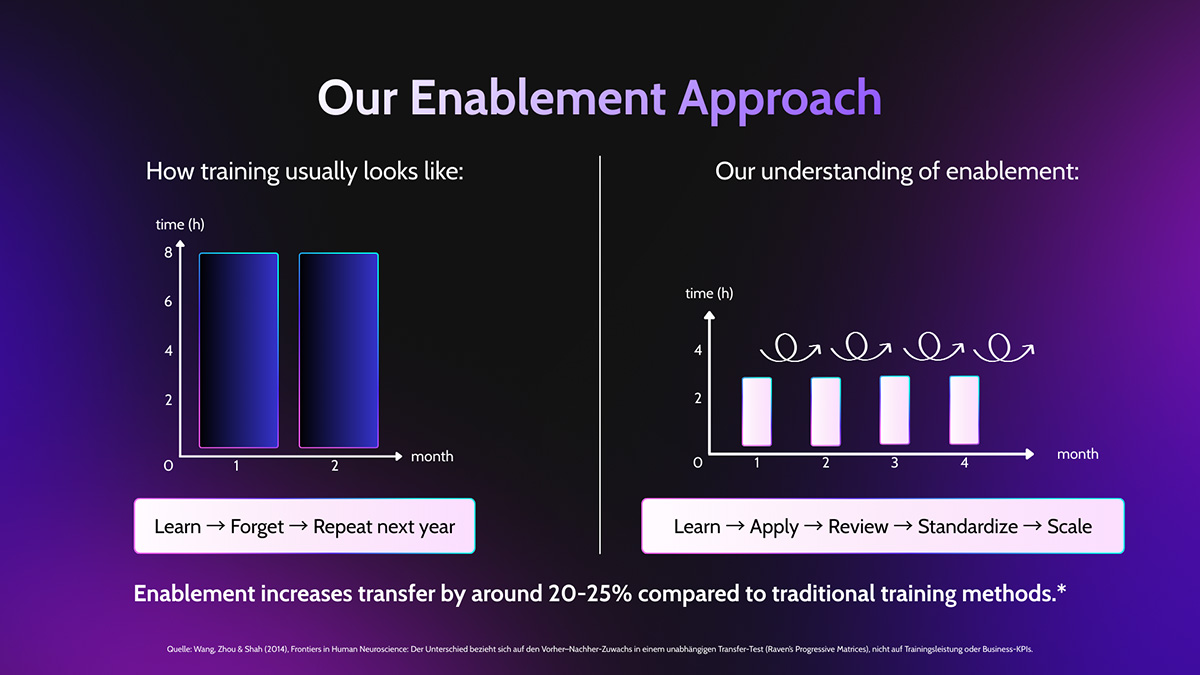
At PMA Academy, we realised early on that AI adoption cannot be solved through isolated training sessions. What organisations need is not instruction but structure.
Instead of asking, “How do we teach people prompting?” – We ask, “How do we redesign how teams think about their work with AI?”
Our AI Enablement approach therefore starts with the business not the tool. Every programme begins by identifying the real operational pressure points within a function: reporting bottlenecks, communication overload, manual analysis, repetitive documentation, and complex stakeholder coordination.
Then we introduce AI — presenting its capabilities and limitations as a response to those challenges. PMA Academy’s use-case-driven AI Enablement System can be applied to any corporate function. It combines:
- Real business use cases — defined by the team
- Guided prompting linked to actual tasks
- Workflow thinking instead of tool thinking
- Team reflection and peer learning
- Leadership involvement
- Online and hybrid learning formats
- A safe AI Playground for experimentation
The goal is not AI training. The goal is organisational capability building.
Actors
The programmes are designed for corporate teams across functions — from HR and Global Mobility to Procurement, Finance, Legal and Operations. Participants typically bring very different levels of AI experience: some have already experimented extensively, others are cautious or just getting started. In addition to operational team members, team leads and decision-makers are actively involved to ensure that enablement is not isolated, but strategically anchored.
Each programme is adapted to the function, maturity level, organisational context, and the concrete challenges of the team. There is no one-size-fits-all curriculum. Instead, the content, examples and exercises are directly aligned with the team’s real workflows and performance pressure points.
Goal
The objective is clear: to enable professionals to confidently integrate AI into their daily work. This means reducing manual and repetitive tasks, improving the quality and speed of decision preparation, increasing clarity in communication and analysis, and ultimately regaining time for more strategic responsibilities.
When implemented successfully, AI does not simply accelerate tasks — it strengthens the overall capability of the function and creates measurable business value.
The Use Case: How PMA Academy Solves It
PMA Academy delivers AI Enablement through a three-phase learning journey that works across functions and industries.
Phase 1 – Foundations & First Application
The first wave builds a shared understanding. Not technical depth — but conceptual clarity. Participants learn how large language models function, where their limitations lie, and how to think in use cases rather than prompts. The goal here is alignment and a shared language. Teams work on function-specific scenarios as a common starting point, learning how to think in use cases and collaborating on live prompting exercises.
This creates a shared AI Playground to test, compare and learn.
Phase 2 – Guided Application
The second wave moves into real work. Participants apply AI to concrete tasks from their daily responsibilities — not hypothetical exercises. They test and refine prompts to draft reports, structure analyses, create communication templates, and support their daily tasks. Participants compare outputs and evaluate them critically.
In guided office hours, teams share current challenges and identify limitations to refine approaches based on feedback from PMA Academy experts. AI becomes useful, not abstract.
Phase 3 – Integration & Enablement
In the final phase, teams present their AI-supported use cases and reflect on impact, risks and limitations. Based on the outcomes, they share what worked and what should become standard practice. Teams define how AI will be used going forward, discussing governance and responsible use.
Leadership becomes involved and AI usage is no longer individual experimentation — it becomes a shared way of working. This step ensures AI is embedded into ways of working, not treated as a one-off experiment. AI stops being a “tool people try” and becomes a capability the team owns.
What Changed in Practice
| Before the programme | After the programme |
| AI tools may already exist but are used inconsistently | Teams know how to apply AI in their specific function |
| No shared AI language across the team | A shared AI language emerges |
| No link between AI use and performance outcomes | AI moves from tool to capability |
| Little time to experiment due to operational pressure | Use cases exist for real daily tasks |
| High uncertainty around compliance, quality and governance | Confidence and adoption increase & Leadership gains transparency on AI impact |
Why This Works
Across organisations and functions, the transformation followed a similar pattern. AI adoption fails when organisations start with the tool. It succeeds when they start with work. The AI Enablement course enables teams to realise where AI adds value to their work and how to integrate it responsibly, shifting conversations from “Is this allowed?” to “How can we improve this workflow further?”.
By anchoring AI in real tasks, creating psychological safety through structured experimentation, and aligning teams around shared application principles, AI becomes practical instead of theoretical.
We don’t train prompt engineers. We enable professionals.
Results Across Organisations
✔ Employees actively use AI in daily tasks
✔ Function-specific business cases are developed
✔ Teams share a common AI language
✔ Leadership sees real value instead of hype
✔ Organisations move from curiosity to capability
Why This Matters for Your Organisation
If your organisation is currently experiencing high curiosity but low integration, the issue is not access. It is architecture.
Without a structured enablement journey AI remains experimental and usage stays inconsistent. This use case shows the answer. You don’t need more tutorials. You need AI Enablement that fits your organisation. With structure, reflection and leadership alignment, AI becomes a performance multiplier across corporate functions.
At PMA Academy, we don’t train prompt engineers. We enable professionals across corporate functions.
How PMA Academy Can Help
Through:
- In-house AI Enablement programmes
- Open PMA Academy courses
- Function-specific AI journeys
- Consulting, research and community
We help organisations turn AI into real business advantage — across functions.
Explore our upcoming AI Enablement courses or contact us for an in-house offer:
Authors:

Daniel Zinner is an international HR expert, entrepreneur, and communications consultant. His expertise lies in HR, strategy, digitalisation, and transformation strategy.

Alexia Schmolling is the Head of Operations and Academy Lead at PMA. Her focus lies on Expat Management, Employee Health and international HRM. She brings valuable insights from her international experiences.