How to Embed AI Safely into Global Mobility Workflows
Artificial Intelligence is entering Global Mobility just as it is entering every other corporate function. Global Mobility is one of the most complex corporate functions in any organisation. It connects tax, payroll, immigration and social security with HR, Legal, Finance, Procurement and IT. It balances employee experience with compliance, governance and business continuity.
The potential of AI was clear: faster case handling, better policy interpretation, stronger compliance preparation, reduced manual documentation and more time for strategic advisory work.
Challenge
A large international organisation with complex global operations, frequent cross-border employee movement, and diverse regulatory environments faced a growing reality: AI tools are everywhere but they do not equate real business impact. Teams can use ChatGPT and similar tools, educating themselves with YouTube tutorials and read LinkedIn posts about prompting. Yet, nothing changed in their daily work.
Why? Because watching videos does not change how Global Mobility work is done. Knowing prompts does not mean knowing how to apply AI to real GM cases and curiosity does not equal AI literacy.
The organisation saw AI’s potential to support Global Mobility Excellence with faster case handling, better compliance preparation and improved policy interpretation. Due to the reduced manual workload, professionals have more time for strategic advisory work.
But 3 barriers repeatedly appeared:
- There was no clear connection between AI usage and actual mobility workflows.(What can AI realistically support in my GM role?)
- There was high uncertainty around compliance, governance and responsible use. (How do I use AI safely in sensitive mobility contexts?)
- There was no shared language and application across the team. (How do I apply AI to real cases — not just demos?)
Without enablement, AI remained a tool without impact. Global Mobility is not a generic workflow environment. It is governed by regulation, sensitive data, cross-border risk and legal accountability. People didn’t know what to use AI for in Global Mobility and how to integrate it into real mobility workflows. Unsure about what was allowed, they didn’t trust outputs for compliance-relevant and legal topics.
Under operational pressure, there was little room to experiment safely. Without structure, AI remains a toy — not a tool. That is why AI Enablement is required.
The System
From Experimentation to Capability Architecture
PMA Academy designed a function-specific AI Enablement System for Global Mobility, combining:
Instead of starting with prompting techniques, we start with Global Mobility work itself. Our Global Mobility AI Enablement course combines real GM use cases, guided prompting linked to sensitive mobility scenarios, workflow thinking instead of tool thinking, structured peer reflection, leadership involvement and hybrid learning formats.
A protected AI Playground creates psychological safety for experimentation without risking compliance.
The goal is not AI training. The goal is capability building inside a compliance-heavy environment.
Actors
The programme was designed for Global Mobility professionals operating in an international corporate environment with high cross-border complexity. Participants brought different levels of AI maturity. Some had already experimented. Others were cautious due to compliance sensitivity.
Team leads and decision-makers were actively involved to ensure that enablement was strategically anchored and not isolated at operational level. Every element of the programme was aligned with real Global Mobility workflows — not generic AI examples.
Goal
To build AI-enabled Procurement Excellence teams to:
- integrate AI into daily GM workflows
- support tax, immigration, and international assignment processes
- reduce manual and repetitive work
- improve decision quality
- regain time for strategic advisory work
- create measurable business value
The Use Case: How PMA Academy Solved It
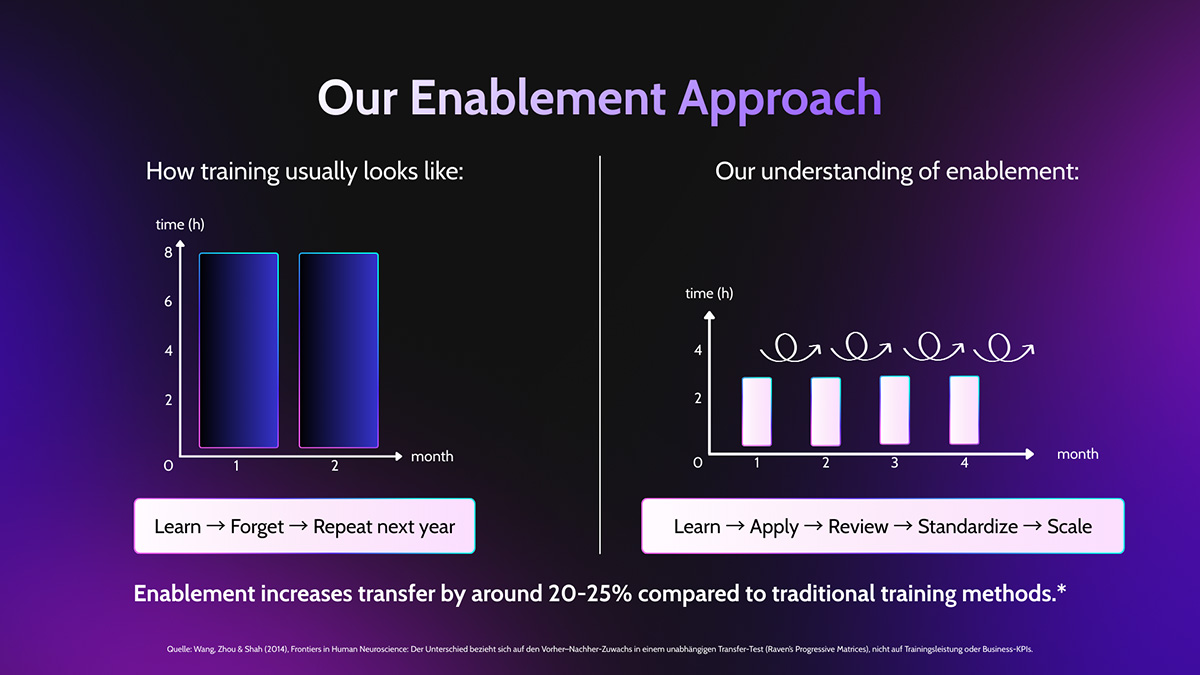
AI Enablement for Global Mobility followed a structured three-wave learning journey designed to move from clarity to application to integration.
Phase 1 – Foundations & Contextual Understanding
The first wave built conceptual clarity. Participants learned how large language models function, where their limitations lie, and how AI should be evaluated in compliance-relevant contexts. More importantly, they learned how to think in Global Mobility use cases instead of prompts.
In structured breakout sessions, teams worked on real scenarios such as policy interpretation, assignment preparation, stakeholder communication drafts, compliance checklists and structured case documentation.
A shared AI Playground was created — a space to test, compare, reflect and learn without risk.
Phase 2 – Guided Application in Real Work
After the first session, participants received real Global Mobility challenges to work on with AI, shifting into operational reality. Participants applied AI to actual Global Mobility tasks from their daily workload. They refined prompts, compared outputs and critically evaluated results.
In guided office hours, limitations were openly discussed. Governance concerns were addressed. Outputs were improved collaboratively. AI shifted from interesting to useful.
Phase 3 – Integration & Organisational Alignment
In the final phase, participants presented their AI-supported use cases and reflected on impact, risk boundaries and responsible integration. Leadership became part of the conversation. Teams defined how AI would be used going forward, where guardrails were required and how knowledge would be shared internally.
AI was no longer individual experimentation. It became a shared capability embedded in Global Mobility workflows. This ensured AI became part of Global Mobility Excellence, not a side experiment. Learning turned into organisational knowledge.
What Changed in Practice
| Before the programme | After the programme |
| AI tools existed but were used inconsistently | Teams knew how to apply AI in Global Mobility & leadership gained visibility into AI’s real value |
| No shared AI language within Global Mobility | Participants built a shared prompt library for everyday GM work |
| No connection between prompting and GM performance | GM-specific use cases existed across key processes |
| No safe space to test, fail, and learn | Confidence increased significantly |
| High operational pressure left little room for experimentation | AI became a professional topic — not a source of fear |
AI moved from tool to capability.
Why this works
AI adoption in Global Mobility succeeds when they start with workflow architecture and governance clarity. By anchoring AI in real mobility tasks, creating psychological safety within compliance boundaries and aligning teams around shared principles of responsible use, AI becomes practical rather than theoretical.
This approach provides an understanding of how to apply AI efficiently and builds confidence through practice. It becomes part of professional judgement — not a replacement for it. AI becomes a driver of Global Mobility Excellence.
✔ Global Mobility professionals actively use AI in daily tasks
✔ Real GM use cases were developed and applied
✔ Teams share a common “AI language”
✔ Leadership gained transparency on AI potential
✔ The organisation moved from curiosity to capability
Why This Matters for Your Organisation
If your Global Mobility function is experiencing high curiosity but low integration, the issue is not access to tools. It is enablement architecture. If you are asking:
How do we make AI useful for Global Mobility?
How do we reduce fear and increase adoption?
How do we free up time for strategic GM work?
This use case shows the answer: With structure, reflection and leadership alignment, it becomes a performance multiplier in even the most compliance-sensitive environments.
You do not need more tutorials. You need structured AI Enablement.
How PMA Can Help You
Through in-house AI Enablement programmes, open PMA Academy courses and function-specific AI journeys, we help Global Mobility teams embed AI responsibly and effectively into their daily work.
We help organisations turn AI into real Global Mobility impact.
Explore our upcoming AI Enablement courses or contact us for an in-house offer and see how your teams can move from experimentation to excellence:
Authors:

Daniel Zinner is an international HR expert, entrepreneur, and communications consultant. His expertise lies in HR, strategy, digitalisation, and transformation strategy.

Alexia Schmolling is the Head of Operations and Academy Lead at PMA. Her focus lies on Expat Management, Employee Health and international HRM. She brings valuable insights from her international experiences.